

With the rise of AI, there has been much discussion about which jobs are safe from automation. Plumbing is often cited as one that is unlikely to be replaced by Claude or Gemini any time soon. It is also one of the trades taught at BluLever Education, a company co-founded by South African entrepreneur Jess Roussos to train plumbers, electricians and other artisans. Roussos is one of the top 10 finalists in the 2026 Africa’s Business Heroes entrepreneurship competition.
How we made it in Africa editor-in-chief Jaco Maritz spoke to Roussos, the company’s co-CEO, about how she and her co-founder built a business that addresses South Africa’s skills gap.
Topics discussed during the video/audio interview include:
Identifying a gap in South Africa’s trades sector
The biggest challenges BluLever has faced
How the founders financed the business
Entrepreneurship lessons learnt along the way
Business opportunities in Africa’s education sector
Interview summary
Prior to starting BluLever Education, South African-born Roussos worked for the African Leadership University (ALU) in Mauritius. ALU is a private higher education network founded by entrepreneur Fred Swaniker in 2015, with campuses in Mauritius and Rwanda. Roussos held several roles there, including in marketing. Her future BluLever co-founder, Adam Collier, also worked at ALU.
After about four years at ALU, Roussos and Collier both wanted to do something new. Roussos says their time there gave them a blueprint for building and scaling an education startup.
They saw an opportunity in vocational training. On the one hand, South Africa had large numbers of unemployed young people. On the other, businesses such as plumbing and electrical contractors were struggling to find skilled workers. According to Roussos, many existing technical and vocational training institutions were not equipping students with the skills employers needed.
Getting started
Roussos and Collier started BluLever towards the end of 2018. Initially, they focused on researching the artisan sector and published their findings in a document called the Artisan Report. They also organised a conference that brought together a range of industry stakeholders.
In 2020, they hired a small team and began running short training programmes, which gave them hands-on experience of working with tradespeople.
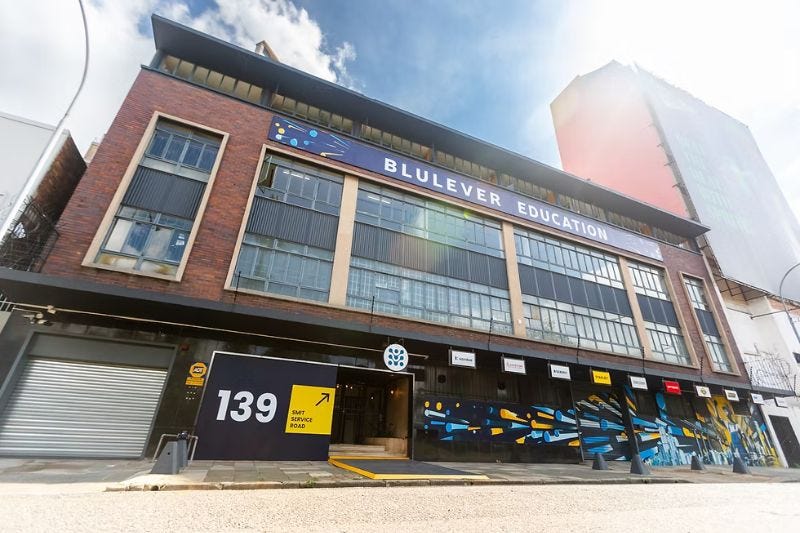
The following year, BluLever opened its first campus in a rented building in Braamfontein, Johannesburg, and enrolled 30 students in its three-year plumbing apprenticeship programme.
Apprentices spend about a third of their time on campus. The rest of the time, they work for an employer, who pays them while they learn on the job. Alongside technical subjects, the campus curriculum covers soft skills such as communication, project management and entrepreneurship.
After three years, BluLever outgrew its first campus and moved to a larger building down the road. It has since added electrical, automotive and solar apprenticeship programmes, and opened a campus in Cape Town.
The plumbing apprenticeship costs R130,000 (about $7,900) over three years, while the electrical and automotive programmes are priced at R145,000 (about $8,800).
Apprentices can fund their studies in several ways. BluLever sources bursaries and scholarships for those who can’t afford the fees, while others make use of student financing or have their tuition covered by their employer. “Generally what will happen is that most apprentices will have a blend of these,” Roussos explains. “They might have, for example, a 60% or 70% bursary, and then the other 30% either they are paying, their employer is paying, or they get a bank loan.”
Funding the business
The founders initially funded the business with their own savings and raised a small amount from family and friends to open the first campus.
In 2023, BluLever secured an equity seed round from four institutional impact investors: the Elea Foundation for Ethics in Globalization, the Autodesk Foundation, the Oppenheimer Generations Foundation and A to Z Impact.
Roussos says the company is now raising another round, which will allow it to open a third and fourth campus.
Plans for growth
To date, BluLever has enrolled just over 700 apprentices across its programmes.
According to Roussos, the biggest obstacle to reaching the scale the company is aiming for is the cost and time involved in setting up physical campuses. “We started thinking about how we can get away from having to do that ourselves,” she explains.
Looking ahead, the founders plan to offer the BluLever model through existing vocational training institutions. This could see BluLever operating government technical and vocational education and training (TVET) colleges, or training centres run by private companies.


