

Several entrepreneurs and investors have identified the storage and preservation of agricultural produce in Africa as an area with compelling opportunities.
In Ghana, maize farmers often sell their full yields immediately after harvest. Because of the mechanics of supply and demand, this is not always the best time to make the product available, as the prices drop when the market becomes saturated. Herein lies an opportunity, according to Ben Kemetse, co-founder of M&B Seeds and Agricultural Services. It is one he has considered pursuing himself. “Our market structure is such that if the price falls so much, the farmer may not make any money at all,” he explains. Warehousing with appropriate technology and processes in place to maintain the integrity and quality of the grain would solve a problem for the farmers and provide a potentially lucrative opportunity for the player offering that space, Kemetse argues.If farmers have a bumper harvest, they could store their cereals and sell them when the market is right.This can be as high as 60% for fresh produce, pointing to unmet demand for temperature-controlled cold-storage warehouses and transportation services.
The manufacturing of cooler sheds for storing perishable agricultural produce is an untapped opportunity in Uganda, according to Lilian Nakigozi, founder of Women Smiles, a company that sells vertical farms used to grow crops in areas where there is limited space. “Currently, Ugandan smallholder farmers lose up to 40% of their fresh produce because of a lack of reliable cold-storage systems. Providing a cheap and reliable 24/7 system would dramatically reduce post-harvest losses for these farmers.”
In neighbouring Rwanda, businessman Jean Bosco Nzeyimana, CEO of Habona, recognises the potential. “There is a major issue. We have so many farms but a lot of harvest is wasted. I also do organic farming and when you do not have immediate customers to buy your crop, it is wasted. There is a massive demand for competent companies that specialise in the storage of agricultural produce.”
Edward Isingoma Matsiko, managing partner of East Africa-focused investment firm Pearl Capital Partners is keen to back the long-term growth of businesses active in post-harvest crop handling and the cold chain.But some businesspeople are tackling these challenges:
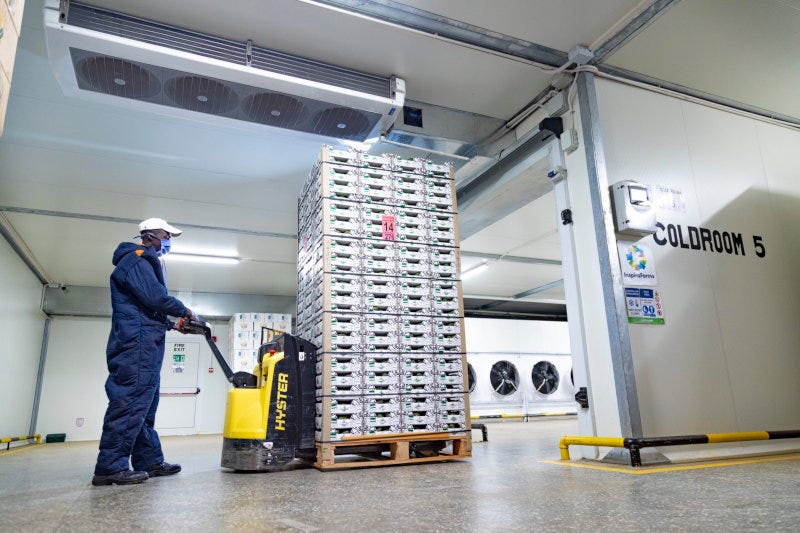
InspiraFarms designs and supplies cold-storage solutions for fresh produce companies in Africa. It has a wide variety of clients, from small-scale farmer groups to large agricultural enterprises. InspiraFarms has developed prefabricated, modular cold-storage technology. The units are portable and can easily be removed or relocated. They are also relatively easy to install in rural areas. To make this more affordable, InspiraFarms presents its clients with a variety of financing options.
Nigeria-based ColdHubs provides solar-powered walk-in cold-room solutions aimed at farmers, retailers and wholesalers. The cold rooms are installed at major food production and consumption centres, such as markets and farms. ColdHubs offers farmers a pay-as-you-store subscription model; they pay a daily flat fee for each crate of food they store.“In Nigeria, over 45% of our fresh food and vegetable production is wasted annually because of the lack of suitable facilities. Seventy per cent of Africa’s food is supplied by smallholder farmers and they are losing so much money because of the post-harvest losses in our fresh food and vegetables. We bridge that gap by helping these smallholder farmers transport it to other temperature-controlled environments,” says Olanrewaju.The company’s flagship facility will be built in the Tatu City Special Economic Zone in Nairobi and has been designed to cater for numerous temperature ranges from +26°C to -40°C across multiple product ranges, from fresh fruit and vegetables, pharmaceuticals and vaccines to meats, poultry and frozen foods.